Preprint · May 2026 Scientific machine learning
Cellular Sheaf Neural Operators for Structure-Preserving Surrogate Modeling of Constrained PDEs
Put the physics on the right cells. Let geometry constrain what the learned update can do.
Georgia Institute of Technology · Florida Institute of Technology
arXiv preprint · arXiv:2606.00937
Compatibility can be built into selected updates through the algebra of a cell complex.
Abstract
Neural operators provide fast surrogate models for PDE simulations, but standard architectures often treat geometry and discretization as secondary to field data. Physical states are usually represented as grid-channel stacks, even when different quantities naturally belong on vertices, edges, faces, cells, boundaries, or interfaces and must satisfy compatibility constraints. We propose Cellular Sheaf Neural Operators, a discretization-aware framework for structure-preserving neural PDE surrogates. The method represents PDE states on oriented cell complexes, couples local feature spaces through learned restriction maps, and uses incidence/Hodge-informed message passing to follow computational geometry. Learned update heads pass through coboundary or flux maps, allowing selected constraints to arise from cell-complex structure rather than only from loss penalties. For magnetohydrodynamics, this yields face-based magnetic-flux updates driven by edge electromotive fields and finite-volume-style fluid updates driven by learned face fluxes and cell sources. On turbulent MHD and fusion-equilibrium surrogate tasks, the method improves structure-sensitive diagnostics, including rollout behavior, divergence control, spectral error, and equilibrium-regression accuracy. These results indicate that cellular-sheaf structure is a useful inductive bias for neural PDE surrogates in constrained multiphysics systems.
The method
Physical variables have geometric roles: circulations can live on edges, fluxes on faces, and conserved quantities in cells. CSNO represents states as cochains on an oriented cell complex instead of treating every variable as another interchangeable grid channel.
Consecutive coboundary maps satisfy d₂d₁ = 0. The preservation statement concerns native cochain divergence.
- 01
Represent fields geometrically
Associate local feature spaces with vertices, edges, faces, and cells. The cell complex supplies incidence structure and Hodge information, connecting the learned representation to a compatible discretization.
- 02
Learn the local coupling
Learn cellular-sheaf restriction maps between incident feature spaces. Incidence/Hodge-informed message passing exchanges information while retaining the different geometric roles of the variables.
- 03
Constrain the update head
For MHD, predict an edge-based electromotive field and update face magnetic flux through the edge-to-face coboundary. Because consecutive coboundary maps compose to zero, this update cannot introduce native cochain magnetic-divergence drift.
Where does a physical quantity live?
Select an element to inspect its role. This wireframe is an illustrative cell, not a production mesh.
Edge electromotive fields
In the MHD specialization, the learned edge electromotive field supplies the magnetic update. The edge-to-face coboundary maps this quantity into a change in face magnetic flux.
Experiments & results
On The Well MHD_64, the comparison separates one-step reconstruction from rollout and structural behavior. CSNO is more compact and improves the tested structure-sensitive diagnostics, while U-Net remains the strongest one-step predictor and dense baselines are faster at inference.
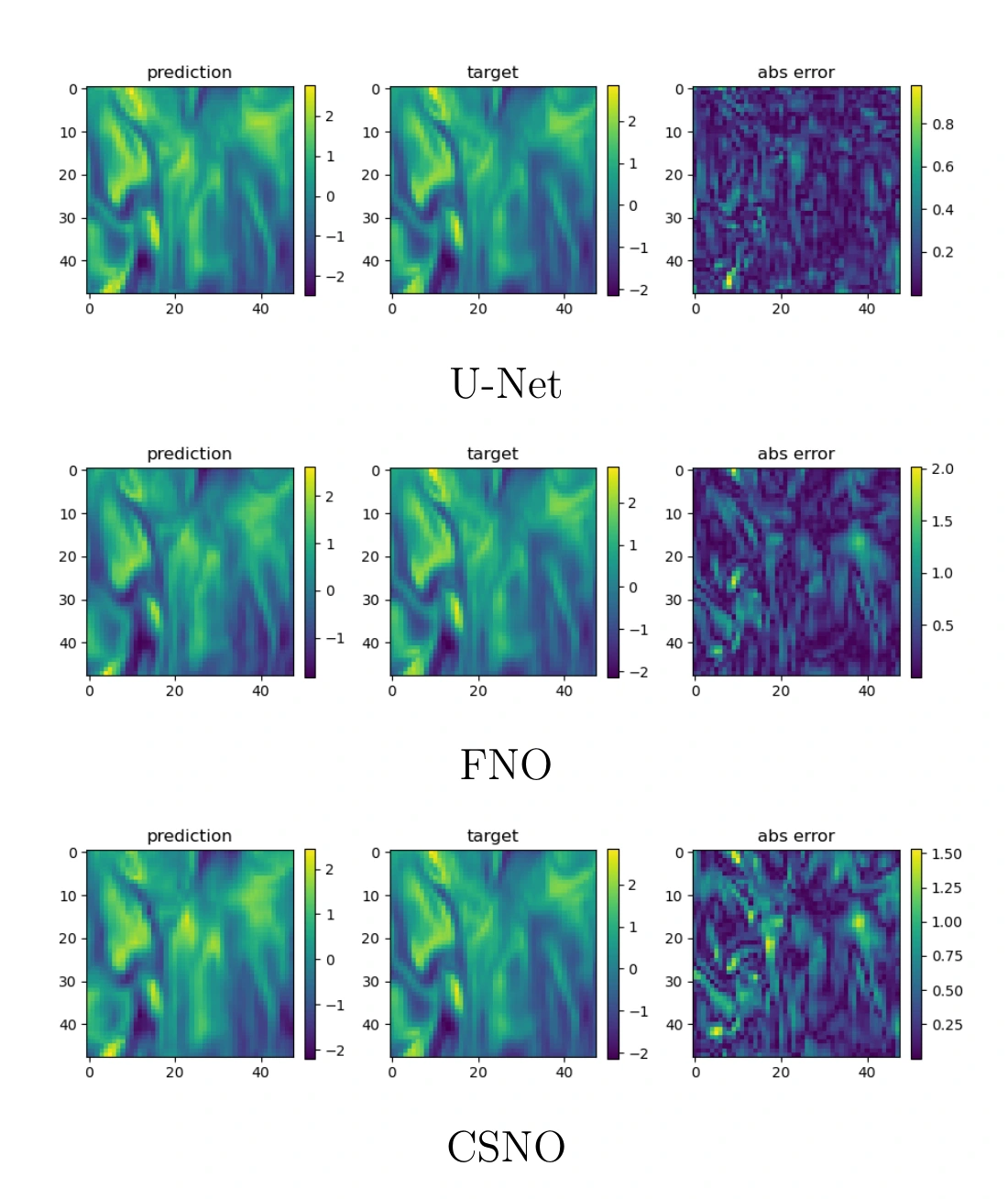
What the models predict
Representative seed-0 one-step MHD predictions, targets, and absolute-error fields for U-Net, FNO, and CSNO. Panels retain the paper’s original color scales; inspect the colorbars rather than comparing color intensity alone.
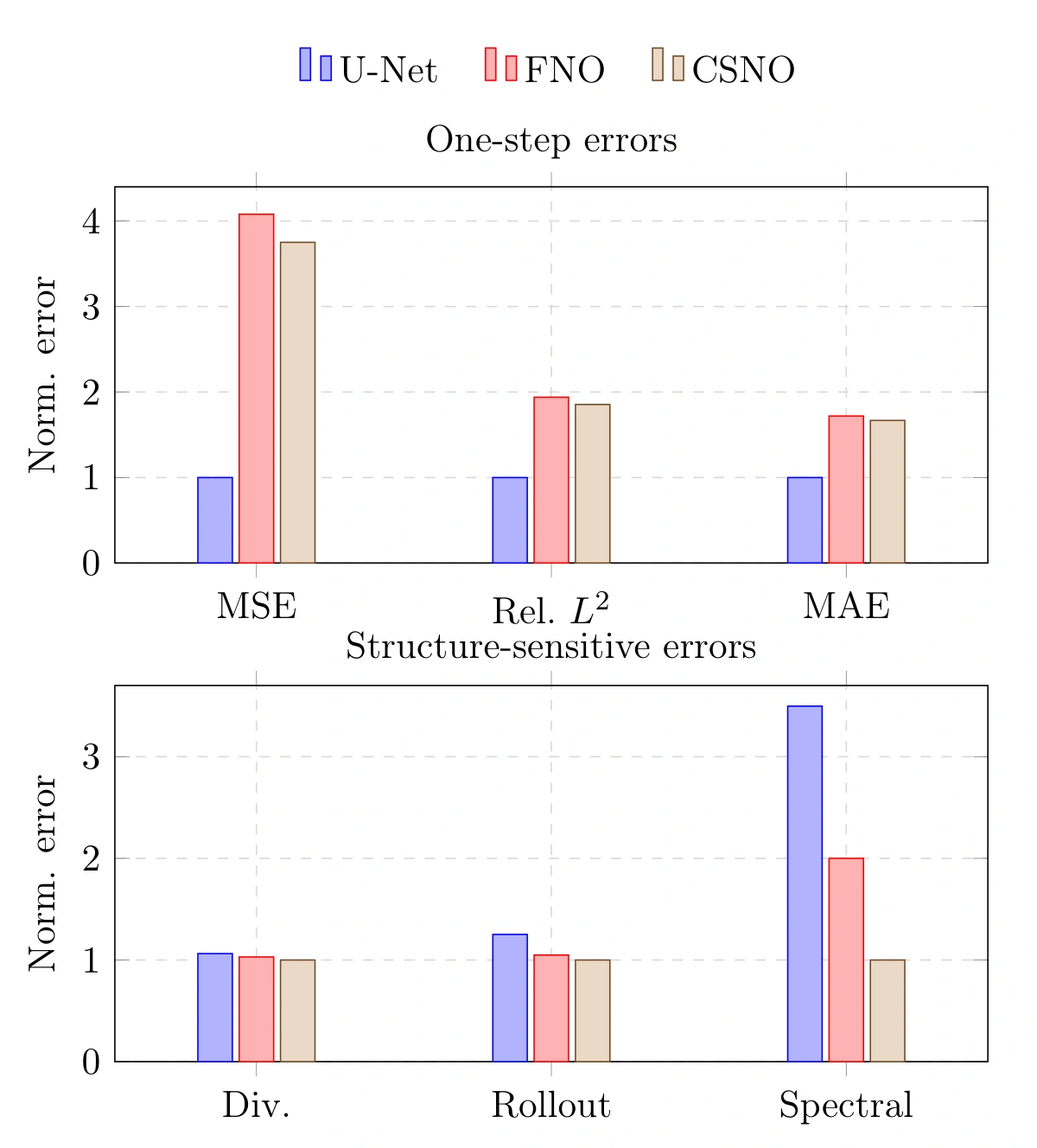
Pointwise accuracy and physical structure separate
Diagnostics normalized by the best model for each metric; lower is better. U-Net leads on one-step tensor errors. CSNO leads on the displayed divergence, rollout, and spectral diagnostics.
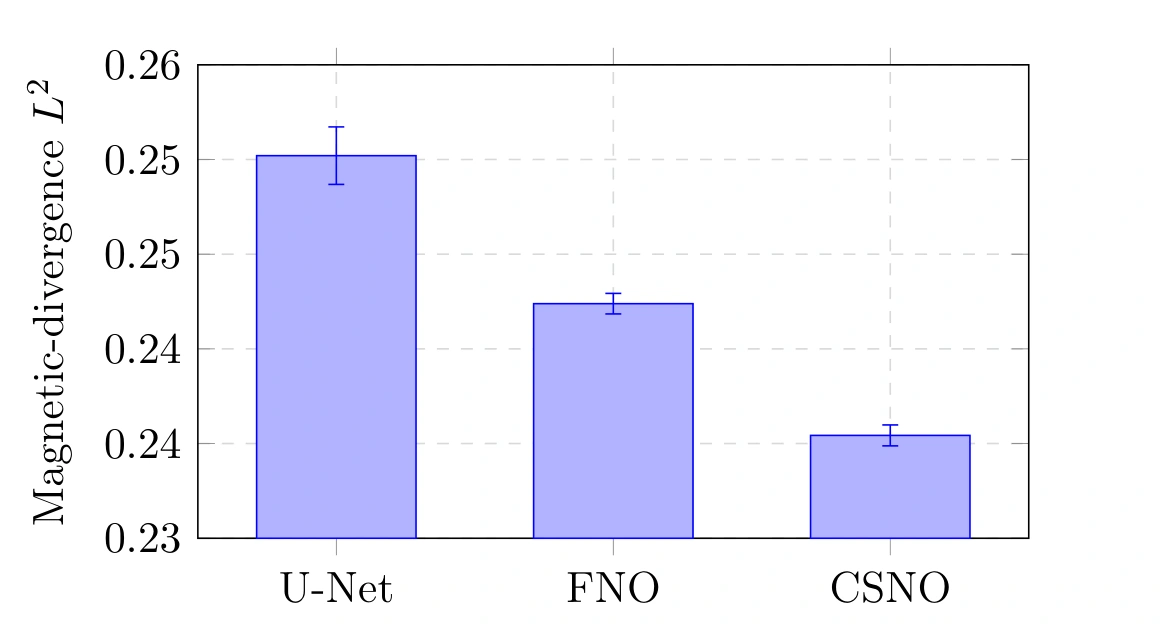
Magnetic-divergence diagnostic
Aggregate grid-space magnetic-divergence L₂ over ten seeds. CSNO has the lowest mean, but the improvement is modest. Error bars show two-sided 95% confidence intervals.
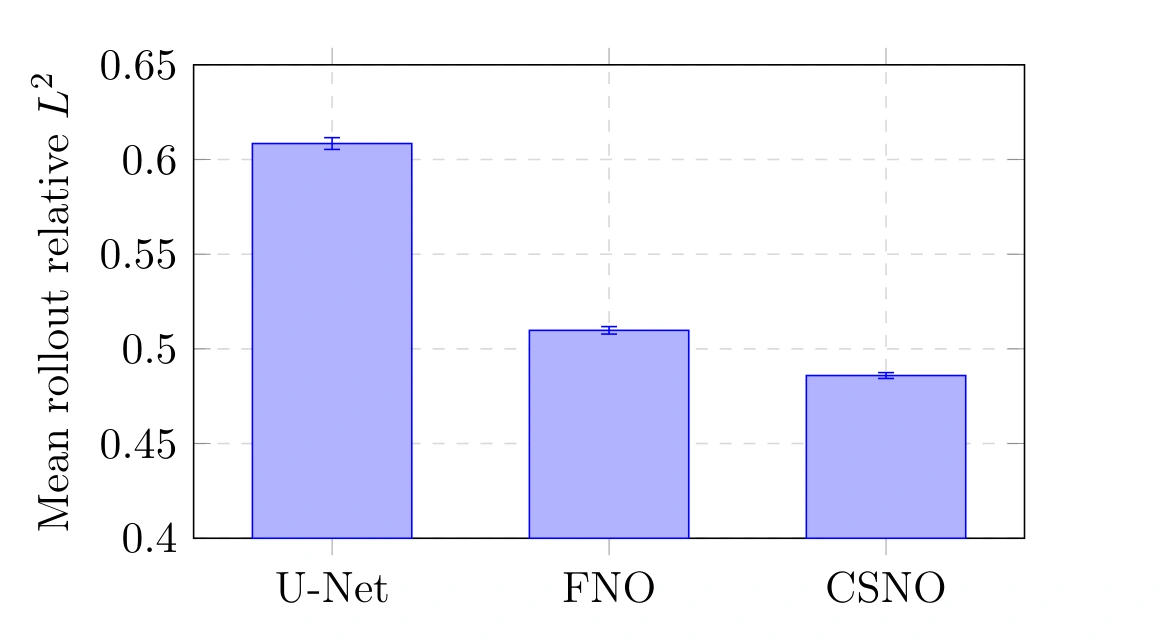
Autoregressive rollout
Mean rollout relative L₂ is 0.608 for U-Net, 0.510 for FNO, and 0.486 for CSNO. Error bars show two-sided 95% confidence intervals over ten seeds.
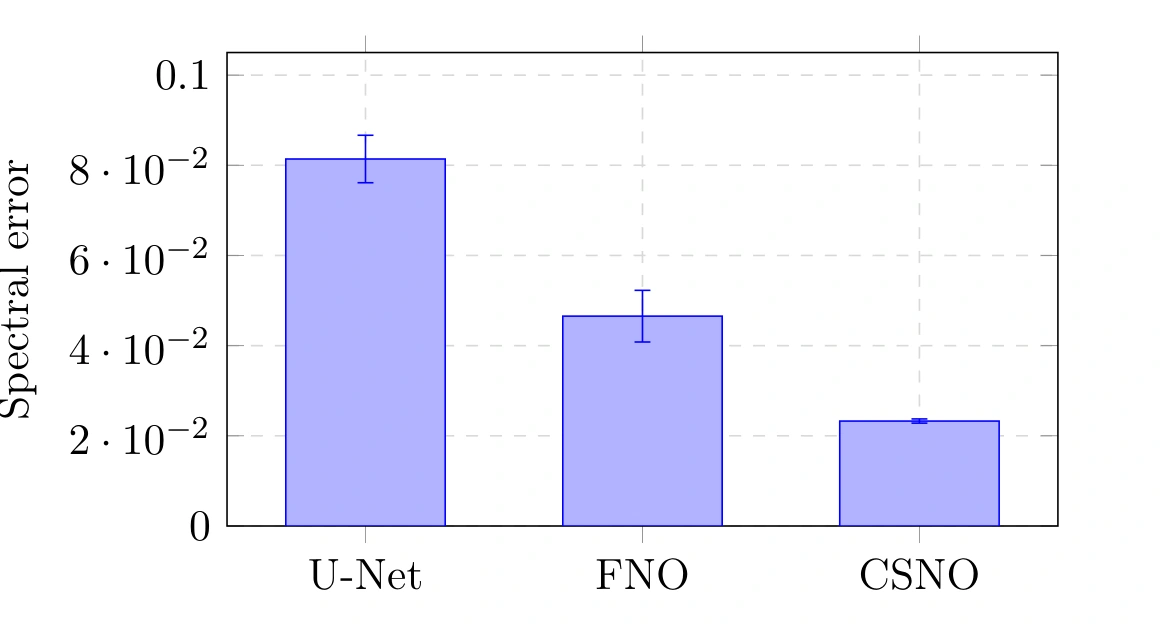
Spectral fidelity
Mean isotropic three-dimensional spectral error is 0.0814 for U-Net, 0.0465 for FNO, and 0.0233 for CSNO, with two-sided 95% confidence intervals over ten seeds.
The Well MHD_64: accuracy, structure, and cost
| Metric | U-Net | FNO | CSNO |
|---|---|---|---|
| One-step relative L₂ ↓ | 0.209 | 0.405 | 0.388 |
| Magnetic-divergence L₂ ↓ | 0.250 | 0.242 | 0.235 |
| Spectral error ↓ | 0.0814 | 0.0465 | 0.0233 |
| Mean rollout relative L₂ ↓ | 0.608 | 0.510 | 0.486 |
| Final rollout relative L₂ ↓ | 0.899 | 0.625 | 0.591 |
| Parameters | 1,290,343 | 2,102,919 | 60,393 |
| Inference time / batch ↓ | 0.0109 | 0.0128 | 0.0212 |
Means from Tables 1 and 3; the paper reports confidence intervals for the error metrics. Inference times are reproduced in the paper’s recorded units. Compactness does not imply faster inference: CSNO is approximately 1.65× slower than FNO in this measured loop.
What the results mean
An algebraic guarantee with a precise scope
Native magnetic cochain divergence is preserved by the update parameterization, independently of network weights. The grid-space diagnostic additionally reflects projection, interpolation, and boundary handling. These are different claims and should be evaluated separately.
Beyond time stepping: equilibrium regression
On ConStellaration, the sheaf-equilibrium model reduces mean relative L₂ from 0.129 for the MLP to 0.0643 over ten seeds. It uses more parameters than the MLP, while recorded inference time per batch is essentially unchanged. This is a regression task, not a second autoregressive PDE benchmark.
Scope and limitations
Time-dependent experiments use structured-grid cubical complexes; genuinely unstructured production meshes remain untested. CSNO does not achieve the best one-step pointwise accuracy on The Well MHD_64 and is slower at inference than the dense baselines despite using fewer parameters. Exact preservation claims concern native cochain updates, rather than every projected grid diagnostic.
Relevant to structure-preserving operator learning, cellular sheaves for scientific machine learning, compatible neural discretizations, and constraint-aware surrogate modeling of magnetohydrodynamics and multiphysics systems.
- Cellular sheaves
- Structure-preserving neural operators
- Compatible discretizations
- Magnetohydrodynamics
- Constrained PDE surrogates
Citation & resources
Lennon J. Shikhman and Shane Gilbertie. Cellular Sheaf Neural Operators for Structure-Preserving Surrogate Modeling of Constrained PDEs. arXiv preprint · arXiv:2606.00937, 2026.
arXiv:2606.00937
@article{shikhman2026cellular,
  title={Cellular Sheaf Neural Operators for Structure-Preserving Surrogate Modeling of Constrained {PDE}s},
  author={Shikhman, Lennon J. and Gilbertie, Shane},
  journal={arXiv preprint arXiv:2606.00937},
  year={2026},
  url={https://arxiv.org/abs/2606.00937}
}
Figures and reported numbers are reproduced from the linked paper. Interactive illustrations and conceptual diagrams are labeled separately.