Workshop paper · 2026 Scientific machine learning
Semigroup Consistency as a Diagnostic for Learned Physics Simulators
A simulator should agree with itself when the same evolution is divided into different time steps.
Georgia Institute of Technology
ICML 2026 Workshop on AI for Physics (AI4Physics)
Temporal coherence is measurable—even without another ground-truth solve.
Abstract
Learned physics simulators are often evaluated by one-step or short-horizon prediction error, but these metrics can miss failures in temporal composition and long-horizon rollout. For autonomous, state-complete systems, exact solution maps satisfy a semigroup law: direct evolution over s + t should agree with evolution over s followed by t. We propose normalized semigroup error as a post hoc, model-agnostic diagnostic comparing these direct and composed learned predictions. On one-dimensional heat and Burgers dynamics with time-conditioned ConvNet and FNO baselines, semigroup error is positively associated with rollout degradation, with trajectory-level Spearman correlation ρ = 0.635 and 95% CI [0.621, 0.649]. Semigroup regularization has mixed effects, supporting semigroup consistency primarily as an evaluation diagnostic rather than a universally beneficial training objective.
The method
An autonomous, state-complete physical system defines a family of evolution maps. Evolving for s and then t must give the same state as evolving once for s + t. A time-conditioned learned simulator can be accurate at individual queried times while violating this relationship.
Compare two learned predictions of the same physical time interval.
- 01
Query two paths
Starting from the same held-out state, compute one prediction over s + t and a second prediction by applying the learned model over s, then over t. The intermediate state is the model’s own output.
- 02
Measure composition error
Normalize the difference between the two predictions by the direct prediction’s norm, with a small stabilizing constant. This produces a diagnostic that can be evaluated without an extra reference trajectory.
- 03
Stress the time partition
Compare seen and unseen time-pair compositions. Evaluate the diagnostic alongside one-step error and long-horizon rollout error to distinguish local prediction accuracy from coherent temporal evolution.
Same interval. Different answers?
An analytic illustration of a deliberately inconsistent surrogate, G(u, t) = exp(−t − βt²)u, for a single decaying Fourier mode. This is an illustration, not a reported experiment.
Set β to zero: exponential decay composes exactly. With β > 0, dividing the same unit interval changes the prediction. Internal consistency alone still does not establish agreement with the true PDE.
Experiments & results
The experiments use periodic one-dimensional heat and viscous Burgers dynamics, time-conditioned convolutional networks, and compact Fourier Neural Operators. Prediction-only and semigroup-regularized training are compared over five seeds.
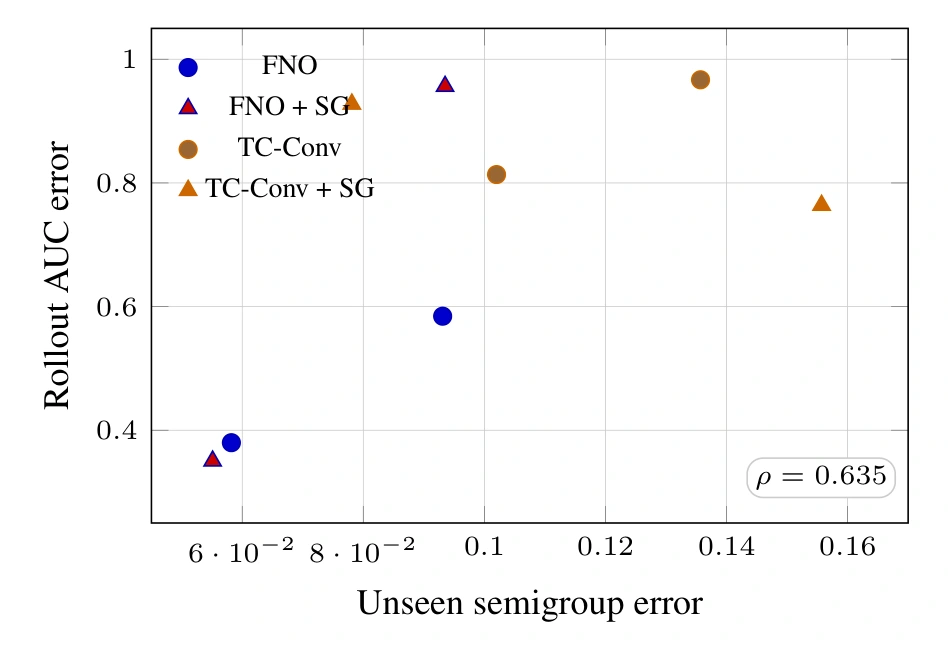
Composition error and rollout degradation
Larger unseen semigroup error is associated with worse rollout AUC error. Points are model-level means; the annotated ρ = 0.635 is computed at trajectory level across held-out evaluations, with 95% CI [0.621, 0.649].
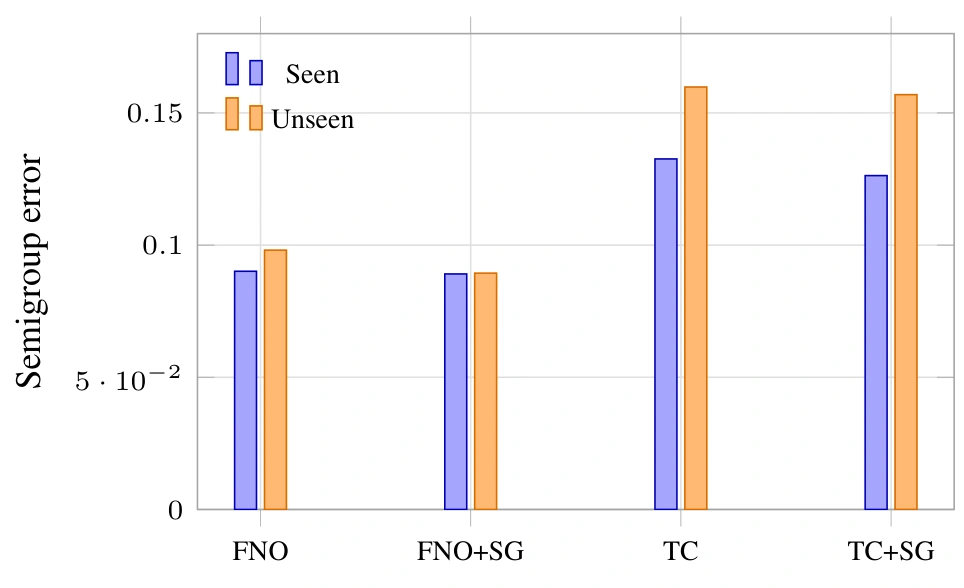
Unseen time partitions expose inconsistency
Seen and unseen semigroup errors averaged across evaluated regimes. Unseen composition pairs increase the aggregate error by 0.0165. The bars show model-level means.
One-step accuracy, rollout error, and temporal consistency
| System | Model | One-step | Rollout | Unseen SG |
|---|---|---|---|---|
| Burgers | FNO1D | 0.066 | 0.380 | 0.058 |
| Burgers | FNO1D + SG | 0.062 | 0.350 | 0.055 |
| Burgers | TC-Conv | 0.118 | 0.967 | 0.136 |
| Burgers | TC-Conv + SG | 0.131 | 0.764 | 0.156 |
| Heat | FNO1D | 0.081 | 0.585 | 0.093 |
| Heat | FNO1D + SG | 0.079 | 0.956 | 0.093 |
| Heat | TC-Conv | 0.145 | 0.814 | 0.102 |
| Heat | TC-Conv + SG | 0.146 | 0.928 | 0.078 |
Table 3 of the paper. In-distribution means; SG denotes semigroup regularization in model names and unseen semigroup error in the final column. Lower errors are better. Rollout values are rollout AUC error, rather than one-step error.
What the results mean
A useful warning signal
Large composition error reveals that the learned simulator does not behave like a coherent autonomous evolution map. This gives a complementary diagnostic even when short-horizon prediction errors look acceptable.
A diagnostic is not automatically a training objective
Adding the semigroup penalty has mixed effects. The aggregate confidence intervals for both semigroup-error improvement and rollout improvement include zero. Optimizing a consistency metric does not, by itself, establish better learned dynamics.
Scope and limitations
The one-parameter semigroup law applies to autonomous, state-complete dynamics. Non-autonomous, controlled, stochastic, or history-dependent systems require an appropriate extension. Small semigroup error does not establish physical correctness. The reported experiments cover compact one-dimensional systems.
Relevant to evaluating neural PDE solvers beyond one-step error, comparing direct and autoregressive predictions, and diagnosing temporal inconsistency under changes in time-step composition.
- Learned physics simulators
- Semigroup consistency
- Temporal composition
- Neural operator evaluation
- Rollout stability
Citation & resources
Lennon J. Shikhman. Semigroup Consistency as a Diagnostic for Learned Physics Simulators. ICML 2026 Workshop on AI for Physics (AI4Physics), 2026.
OpenReview MeAFOZnrvM · arXiv:2605.26324
@inproceedings{shikhman2026semigroup,
  title={Semigroup Consistency as a Diagnostic for Learned Physics Simulators},
  author={Shikhman, Lennon J.},
  booktitle={ICML 2026 Workshop on AI for Physics},
  year={2026},
  url={https://openreview.net/forum?id=MeAFOZnrvM}
}
Figures and reported numbers are reproduced from the linked paper. Interactive illustrations and conceptual diagrams are labeled separately.